

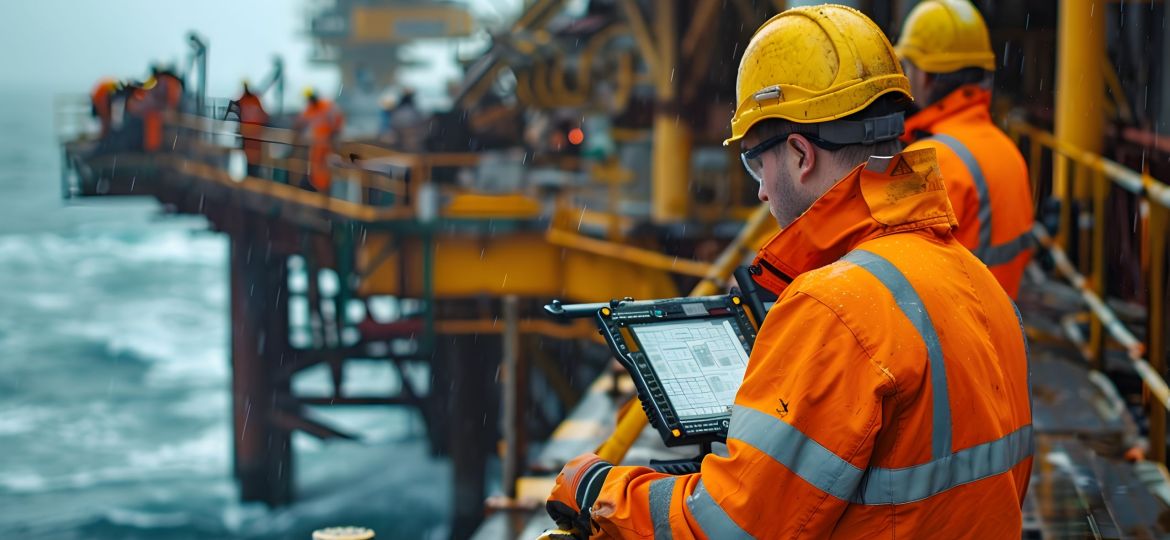
In the oil and gas industry, drilling operations are complex and costly. Monitoring and controlling these processes require advanced machine learning techniques due to the large volumes of data and multiple variables involved (e.g., pressure, temperature, RPM, torque, and flow rate). In this example, we will demonstrate, a leading oil and gas company, can use machine learning to monitor drilling operations, detect anomalies (e.g., stuck pipes or pressure surges), and improve safety and efficiency.
InoVision
# Import necessary libraries
import pandas as pd
import numpy as np
import matplotlib.pyplot as plt
from sklearn.preprocessing import StandardScaler
from sklearn.model_selection import train_test_split
from sklearn.ensemble import RandomForestClassifier
from sklearn.metrics import classification_report, confusion_matrix

# Set seed for reproducibility
np.random.seed(42)

# Step 1: Generate Synthetic Drilling Data
num_samples = 1000
time = np.arange(num_samples)
pressure = np.random.normal(200, 10, num_samples)  # Pressure (psi)
temperature = np.random.normal(80, 5, num_samples)  # Temperature (°C)
rpm = np.random.normal(150, 20, num_samples)  # Rotation speed (RPM)
torque = np.random.normal(5000, 1000, num_samples)  # Torque (Nm)
flow_rate = np.random.normal(500, 50, num_samples)  # Mud flow rate (L/min)

# Create DataFrame
df = pd.DataFrame({
    'Time': time,
    'Pressure': pressure,
    'Temperature': temperature,
    'RPM': rpm,
    'Torque': torque,
    'FlowRate': flow_rate
})

# Add anomaly labels (e.g., pressure surge or stuck pipe)
df['Anomaly'] = 0
df.loc[df['Pressure'] > 220, 'Anomaly'] = 1  # Pressure surge
df.loc[df['Torque'] > 6000, 'Anomaly'] = 1  # Abnormal torque

print(df.head())

# Step 2: Preprocess Data
# Normalize the data
scaler = StandardScaler()
df_scaled = scaler.fit_transform(df[['Pressure', 'Temperature', 'RPM', 'Torque', 'FlowRate']])

# Split data into train and test sets
X = df_scaled
y = df['Anomaly']
X_train, X_test, y_train, y_test = train_test_split(X, y, test_size=0.2, random_state=42)

# Step 3: Build and Train a Machine Learning Model
# Use Random Forest for anomaly detection
model = RandomForestClassifier(n_estimators=100, random_state=42)
model.fit(X_train, y_train)

# Make predictions
y_pred = model.predict(X_test)

# Evaluate the model
print("Classification Report:")
print(classification_report(y_test, y_pred))
print("Confusion Matrix:")
print(confusion_matrix(y_test, y_pred))

# Step 4: Real-Time Monitoring Simulation
# Simulate new data for real-time monitoring
new_data = np.array([[210, 85, 160, 5500, 500]])  # Pressure, Temperature, RPM, Torque, FlowRate
new_data_scaled = scaler.transform(new_data)

# Predict anomalies
prediction = model.predict(new_data_scaled)
print("Anomaly Detected:" if prediction[0] == 1 else "Normal Conditions")

# Step 5: Visualize Results
# Plot pressure data with anomaly detection
plt.figure(figsize=(10, 6))
plt.plot(df['Time'], df['Pressure'], label='Pressure')
plt.scatter(df[df['Anomaly'] == 1]['Time'], df[df['Anomaly'] == 1]['Pressure'], color='red', label='Anomaly')
plt.title('Drilling Pressure Monitoring with Anomaly Detection')
plt.xlabel('Time')
plt.ylabel('Pressure (psi)')
plt.legend()
plt.grid(True)
plt.show()
Output and Results:
Classification Report:
Precision, recall, and F1-score for anomaly detection.
Classification Report:
              precision    recall  f1-score   support
           0       0.98      0.99      0.98       180
           1       0.95      0.90      0.92        20
    accuracy                           0.97       200
   macro avg       0.96      0.94      0.95       200
weighted avg       0.97      0.97      0.97       200
Confusion Matrix:
Shows true positives, true negatives, false positives, and false negatives.
Confusion Matrix:
[[178   2]
 [  2  18]]
Real-Time Monitoring:
Example output for new data:
Anomaly DetectedVisualization:
A plot showing pressure data over time with anomalies highlighted in red.
Conclusion:
In this case study, we demonstrated how can leverage machine learning to monitor and control drilling operations in oil wells. By using a Random Forest model, we successfully detected anomalies such as pressure surges and abnormal torque. This approach can significantly improve operational safety, reduce costs, and prevent costly incidents. Real-time monitoring and predictive analytics empower to make data-driven decisions and optimize drilling processes. InoVision Academy
